
Signs you need a wheel alignment in Apple Valley, MN
Alignment trouble shows up in how the car drives and how the tires wear. Watch for these:
- The car drifts left or right on a straight, flat road.
- The steering wheel is off center while you drive straight ahead.
- The inside or outside edge of a tire is wearing faster than the middle.
- Tires scrub or squeal in slow, tight turns, like a parking lot.
- You keep making small steering corrections just to stay in your lane.
A pull can also come from a dragging brake caliper or a tire with a shifted belt inside it. We check for those before blaming the alignment, because sometimes the real fix is a brake repair.
Potholes, curbs and frost heaves
Alignment is a set of angles. Toe is whether the fronts of the tires point toward or away from each other. Camber is how far the top of each tire leans in or out. Caster is the tilt of the steering axis, and it is what makes the wheel want to return to center after a turn. Adjustable steering and suspension parts hold those angles, and a hard hit can move them.
Spring is pothole season here. Freeze and thaw cycles break up side streets and county roads, and one sharp hit or a slide into a curb on an icy morning is enough to shift the toe. Toe that is off even slightly drags each tire a little bit sideways with every turn of the wheel. You will not feel it, but you will see it on the tread a few thousand miles later.
After suspension or steering parts are replaced
New tie rod ends, control arms, struts or ball joints change the geometry the old parts were set to. An alignment afterward is part of doing that repair right, not an add-on. When we do suspension repair, we tell you up front if an alignment needs to go with it.
New tires are another good time to check. Mounting fresh tires on a car with bad toe settings wears them out early. Our tire service page covers rotation and tire checks.
How we set your alignment
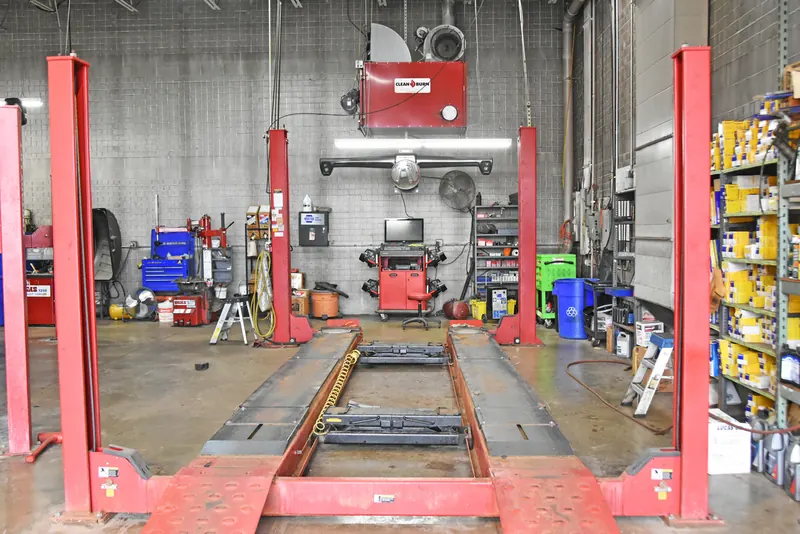
The car goes up on the alignment rack and we attach the machine's sensors to the wheels. The computerized alignment machine reads the current angles and compares them to the manufacturer's specifications for your vehicle. We adjust what can be adjusted, then take a final reading.
First, though, we check for worn parts. A loose tie rod end or a worn ball joint will not hold an alignment, and setting the angles on top of worn parts wastes your money. If we find wear, we stop and call you with what we found and what it costs before doing more. You approve the work before it starts.
One honest limit: not every angle is adjustable on every car. On some vehicles camber is fixed at the factory, and correcting it takes an add-on part or means something is bent. If that comes up, we will explain your options.
What an alignment will not fix
An alignment will not cure a shake at highway speed. That is usually a tire out of balance or a damaged tire. It will not straighten a bent wheel, and it will not undo wear that is already on your tires. What it does is stop that wear from getting worse and get the car tracking straight again.
Questions about wheel alignment
How long does a wheel alignment take?
On most cars the alignment itself is not a long job. Rusted adjusters, which are common on Minnesota cars, can add time. Call (952) 432-2112 with your year, make and model and we can give you a better idea.
How often should I get my wheels aligned?
There is no set mileage. Have it checked after a hard pothole or curb hit, when you put on new tires, after steering or suspension parts are replaced, or any time the car pulls or the steering wheel sits crooked.
Can I drive with my car out of alignment?
Usually, for a short time. The tires wear faster every mile, and a car that pulls is harder to control on slick roads. If the pull started suddenly after a hit, have it looked at soon in case a part is bent.
Do I need a front-end or a four-wheel alignment?
It depends on the vehicle. Many newer cars have adjustable rear angles as well as front, and we set what your car's design calls for.