
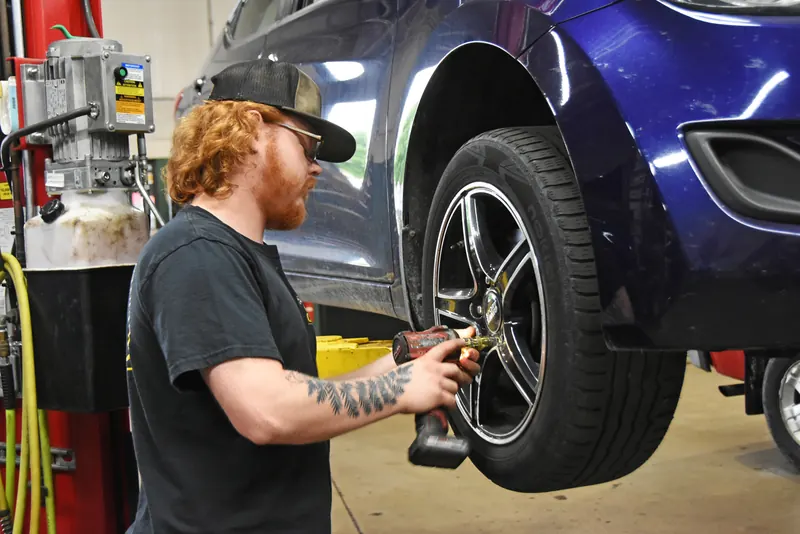
Tire service we handle in Apple Valley, MN
Here is what we take care of in the shop:
- Tire inspection: tread depth, wear patterns, sidewall cracks, bulges, and nails or screws in the tread.
- Rotation: moving the tires between positions so they wear evenly.
- Balancing: correcting small weight differences in the tire and wheel that cause a shake at highway speed.
- Flats and slow leaks: finding where the air is going and whether the tire can be repaired or has to be replaced.
- Replacement: help choosing a tire that fits your car and the way you drive.
Call with your tire size
Your tire size is printed on the sidewall. It looks something like 225/65R17: the width in millimeters, the sidewall height as a percentage of that width, and the wheel diameter in inches. The same number is on the sticker inside the driver's door jamb. Have it ready when you call (952) 432-2112 about replacement tires, along with your year, make and model, and we can tell you what we can do.
When a tire needs attention
Tread depth matters most. A tire is worn out at 2/32 of an inch, which is where the top of Lincoln's head shows when you put a penny upside down in the groove. Plenty of Minnesota drivers replace sooner than that. Shallow tread cannot push slush out of the way, so the tire rides up on top of it instead of biting the road.
Other reasons to call: a bulge or bubble in the sidewall, which means the cords inside are broken and the tire can fail. A tire you have to fill every week. A vibration that started after a pothole. A tire pressure light that keeps coming back.
On that last one, check the pressure before assuming a leak. Tires lose roughly 1 psi for every 10 degrees the temperature drops, so the light often comes on the first cold morning in fall.
Uneven wear has a cause
Replacing a tire without asking why it wore out is how people end up buying tires twice. A front tire that is bald on the inside edge and fine everywhere else is pointing at the alignment, not at the tire. Cupping, a scalloped pattern of high and low spots around the tread, often comes from worn shocks or struts letting the tire bounce.
We look at the wear pattern and tell you what caused it. If the trouble started with the alignment or the suspension, we will say so and send you to wheel alignment or suspension repair before your next set of tires pays the price.
Tires and the rest of the car
With the wheels off for a rotation, the brake pads and rotors are in plain view. If we see brake wear, we show you and tell you whether it needs attention now or can wait; our brake repair page explains what we look for. Many drivers line up a rotation with an oil change since the intervals land close together.
Questions about tire service
What should I have ready when I call about tires?
Your tire size from the sidewall or the door jamb sticker, plus your vehicle's year, make and model. If a tire is damaged, tell us where the damage is and how the car is driving.
How often should tires be rotated?
Many manufacturers call for a rotation somewhere between 5,000 and 7,500 miles, and your owner's manual lists the interval for your car. All-wheel-drive vehicles are especially sensitive to uneven wear between tires, so staying on schedule matters more there.
Can a tire with a nail in it be repaired?
Often, if the puncture is small and in the main tread area. A puncture in the sidewall or the shoulder next to it usually means replacing the tire, because that part flexes and a repair will not hold.
Why does my car shake at highway speed?
A shake that shows up at highway speed and eases off above or below it is commonly a tire out of balance, and we balance tires right here in the shop. A bent wheel, a damaged tire or worn suspension parts can feel similar, so we check those too.