
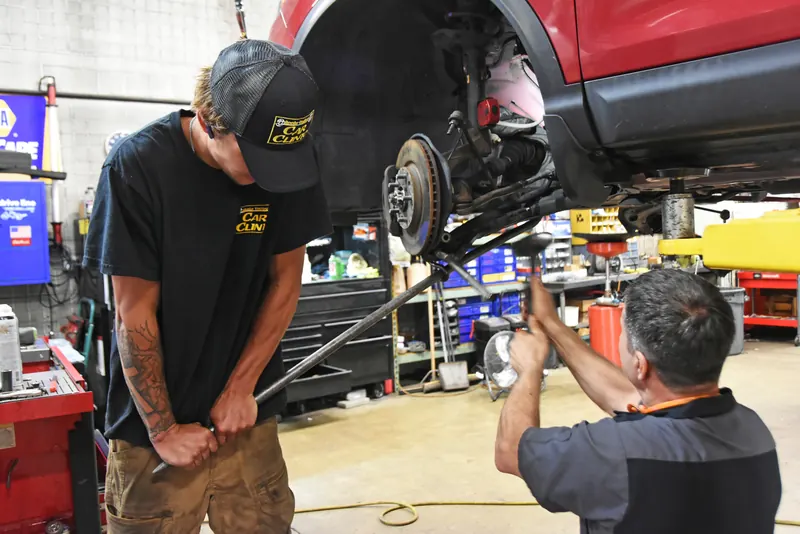
Symptoms of worn suspension parts
- A clunk or knock over bumps, speed humps or railroad tracks.
- The car keeps bouncing after a dip instead of settling.
- The nose dives hard when you brake.
- The body leans more than it used to in turns.
- Play in the steering wheel, or a car that wanders on the highway.
- Cupped or uneven tire wear.
- One corner of the car sitting lower than the others.
Suspension repair in Apple Valley, MN: what we check
Your suspension holds the car up, keeps the tires pressed to the road and gives the steering something solid to work with. These are the parts we inspect:
- Shocks and struts control bounce. On many cars the strut also carries the spring and is part of the steering.
- Ball joints are the pivots that let each front wheel move up and down and turn. A badly worn one can separate, and the wheel can fold under the car.
- Tie rods link the steering rack to the wheels. Wear here feels like loose, vague steering.
- Control arms and their bushings hold the wheel in position. Cracked rubber bushings clunk and make the handling sloppy.
- Sway bar links keep the body from rolling in corners. Worn links are a classic source of a light clunk over small bumps.
When the complaint is in the steering itself, we look at the steering rack, power steering hoses and fluid too.
Minnesota roads are hard on suspension
Potholes are the obvious culprit. Frost heaves are the quiet one. Every winter the ground freezes and lifts the pavement, and the dips and humps that form load the same joints over and over, thousands of times a season. Road salt adds rust. Seized strut mounts, rusted sway bar links and control arm bolts that will not come out are common here, and they are part of why a suspension job in this state can take longer than expected.
If you hit a pothole hard and the car now pulls, clunks or has a crooked steering wheel, something may be bent, not just worn. Have it looked at before your next long drive.
What is urgent and what can wait
Not all suspension wear is an emergency, and we will tell you which is which. A tired shock makes the ride worse and wears tires faster, but it rarely leaves anyone stranded. A ball joint with heavy play or a loose tie rod end is a different story, because those parts keep the wheel on its path.
Most jobs go the way we estimate. Sometimes a seized bolt or a second worn part turns up once the car is apart. When that happens, we stop, call you with what we found and what it costs, and wait for your OK.
Alignment, tires and brakes
Replacing struts, tie rods, control arms or ball joints changes the steering angles, so most of these repairs should be followed by a wheel alignment on our alignment rack. Skip it and the new parts end up chewing through your tires. If your tires already show cupping or edge wear, see our tire service page. A pull or a pulsing pedal only when you stop is more likely a brake problem; our brake repair page covers that.
Questions about suspension repair
How do I know if my shocks or struts are worn?
Push down hard on one corner of the car and let go. If it bounces more than once or twice before settling, the shocks or struts are likely worn. A test drive and a look on the lift tell us for sure.
Should struts be replaced in pairs?
In most cases, yes. Replacing both struts on the same axle keeps the two sides responding the same way, while a single new strut next to a worn one can leave the car handling unevenly.
What is the clunk I hear over bumps?
The usual suspects are sway bar links, control arm bushings, ball joints and strut mounts. The sound alone does not tell us which one, so we check each part for play with the car on the lift.
Is it safe to drive with a bad ball joint?
It depends on how worn it is. Mild wear can be scheduled, but a ball joint with heavy play can fail and let the wheel collapse, so if we find one in that state we will tell you plainly.